
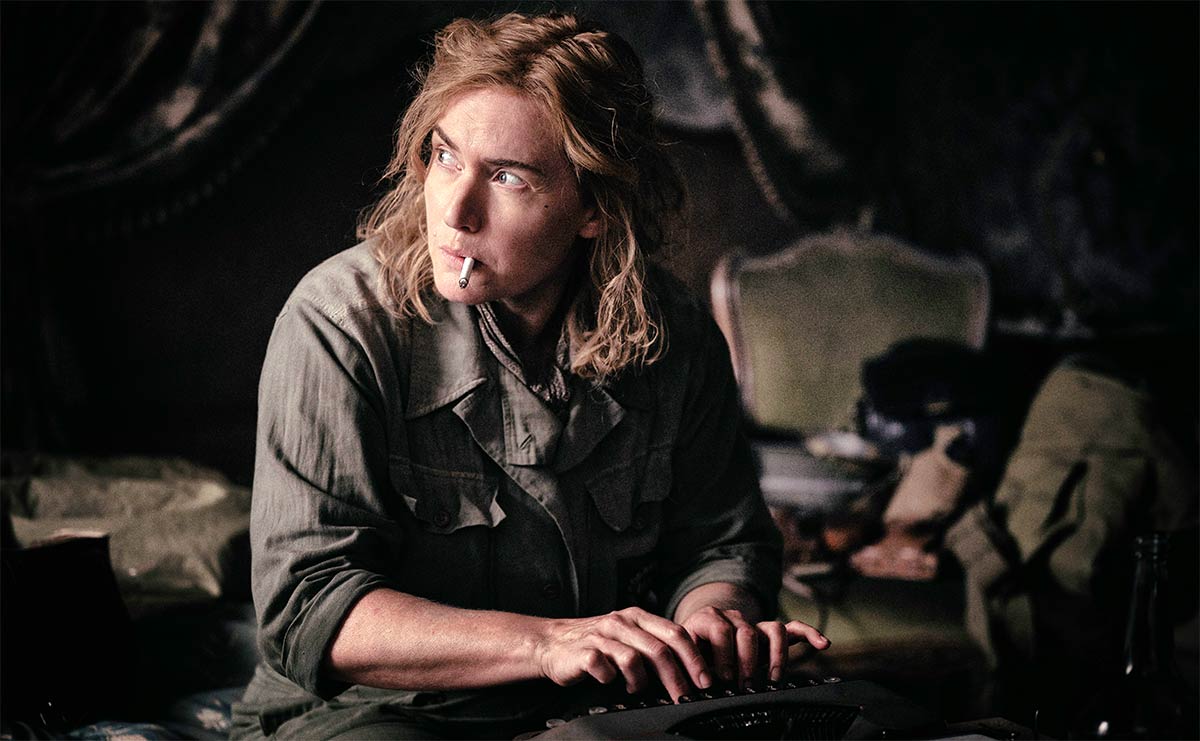
 Kate Winslet in "Lee" The story of Lee Miller is deeply fascinating on paper. From avant-garde muse and fashion model, to war photographer and photojournalist, Miller explored the realms of several worlds in one shot. She went from being the subject of images, to the person behind the lens controlling the perspective. Among her many accomplishments, Miller is responsible for some of the most haunting and piercing images taken from the aftermath of World War II. Miller’s time spent on the frontlines of war, as well as her fight to publish the images she took of the atrocities that happened, are just a snapshot of a trailblazing legacy. To put this role into the hands of Kate Winslet, who plays Miller in Ellen Kuras’s feature narrative directorial debut “Lee,” seems a no-brainer choice. Winslet serves as a producer on the film, her passion project following years of meticulous research and immersion into the subject. Why Lee Miller? The character, entrenched in rich personal and historical material, is an exciting canvas for Winslet to explore. Though while she paints a compelling picture herself, the film leaves more of a blank page behind, leaning too prosaic to fully convey how fascinating a subject Lee Miller is. “Lee” is beholden to Winslet’s emotionally present performance; she brings an energy that the film at times struggles to catch up with.
Given the vastness of Miller’s life, it makes sense to focus only on certain periods in a narrative, which “Lee” technically does: frolicking artists in France, London domesticity, and war across Europe. The film begins in the 1970s with an older version of Lee (Winslet) talking to a young journalist Antony (Josh O’Connor) about her life, as they go through a series of photographs in a living room. Winslet narrates the film through time-spanning flashbacks, powerful imagery, and haunting secrets. The story consistently returns to her and O’Connor’s discussion, which reflects on the emotional impact Miller’s photographic work had, not only on her surroundings and the world at large, but on herself. How does she view her past? What personal memory does each image unlock? Director Ellen Kuras explores “Lee” in and around this line of questioning. Nearly everything that the viewer sees is directly through Lee Miller’s lens, with Winslet present in each and every frame. “Lee” tackles the subject’s life from within prominent decades. The first act explores 1930s South of France, where Lee mingles with artistic friends including fashion editor Solange D’Ayen (Marion Cotillard) and artist Nusch Eluard (Noémie Merlant). Lee’s soon-to-be lover, surrealist artist Roland Penrose (Alexander Skarsgård) strolls up to the sun-kissed party, and the two exchange a dynamic conversation, taking turns psychoanalyzing each other. Moments later comes the early blossoming of a romance, and the rest is history. Towards the film’s middle act, Lee moves to London with Roland and becomes his muse. While he paints absurdist works, she finds employment with magazine editor Audrey Withers (Andrea Riseborough) at British Vogue. During her time at the magazine, Lee gets photojournalist accreditation with the American army and joins the front lines of World War II. At this point in the story, she teams up with LIFE magazine photographer David E. Scherman (Andy Samberg) to document the liberation of Paris, the aftermath of Nazi Germany, and the horrors of the concentration camps. All the while, Lee reckons with a painful secret from her past that unravels in the film’s strong final act. Winslet coming to terms with a harrowing experience she had long buried is an astonishing piece of acting. Though the quality of such material is something she doesn’t receive enough of in the film. The screenplay (co-penned by Liz Hannah, Marion Hume, and John Collee) explores Lee’s perspective as a paradoxical figure. On the one hand, she is determined to expose hard-hitting truths. Her voice throughout the film speaks to the urgency of her work and the impact that historical events have on her career (leading to the shift from Miller as a Vogue model to a war correspondent). The realities she witnesses demand to be seen and shared. On the other hand, Lee Miller the person is more of a closed book to some. While she fights to keep photographic memories alive and wants her work to be shared with the world (echoed by Winslet in an impassioned speech to Riseborough), these contributions are kept secret from Lee’s family. The writing explores an interesting dichotomy between which truths to tell, and which to hide. What gives the film intrigue is its questioning of what people ought to (or are ready to) see through Miller’s perspective. Whether it’s the readers of a fashion magazine, those closest to her personal life, or how the subjects of images are portrayed. In a scene between Lee and the journalist Antony, she questions whether he finds it wrong that she posed for a photograph in the bathtub of Hitler’s abandoned Munich apartment. Lee’s question, and the sense of resilience in her demeanor, is a resonating reminder of just how much power an image can hold, decades after being taken. Her determination to capture moments because she feels the significance of them being seen is a sentiment just as prevalent today as it was forty years ago. The screenplay has potential to further explore rich material such as this, however, often goes about telling the story in a surprisingly monotonous way that feels too reserved for its fearless subject. Where the writing lacks in fervor, Kate Winslet makes up for in spades. “Lee” is a wonderful acting showcase for her to live and breathe the character of Lee Miller. Her performance is a fascinating portrait of a no-nonsense spirit who carries the emotional aftermath of repressed pain. She immediately establishes a connection to the audience and gets to the emotional core of Miller. Her exploration of the character’s psyche and fight to tell the truth builds towards a heart-wrenching moment in the final act. In light of her war images not being published in Vogue, she begins to wrestle with a personal truth that comes out. It’s the sort of moment that jolts you to reflect on just how extraordinary an actor she is, which is not a surprise of course, but nevertheless marks exciting new territory in her range. “Lee” is a multi-faceted role that Winslet tackles with remarkable detail and a commanding presence. If only she were given more opportunities within the film to showcase a deeper characterization, as the third act provides. The talented supporting cast of “Lee” is not given much material to work with, beyond moving the plot along. A chameleonic Riseborough stands out as Withers and shares in one of the most heartbreaking scenes of the film. As does Andy Samberg, whose initially aloof presence settles into a subtle and introspective performance. His character Scherman, hyper-aware of his surroundings, eventually reaches an emotional breaking point when he and Lee start visiting the concentration camps and the abandoned Munich apartment. The haunting visitation sequences in the final act are among the film’s most visceral and emotionally charged moments. Kuras shows atrocities through Lee’s photographs, as well as in the reactions on Lee and Scherman’s faces. These sequences highlight the strengths of Kuras’s visual communication with the audience. Alongside the work of cinematographer Pawel Edelman, the decisions on what to show, in addition to when and how, are made carefully. As a photographer and cinematographer herself, Kuras has a unique perspective on visual storytelling. Beautifully exhibited in films such as “Eternal Sunshine of the Spotless Mind” and “David Byrne’s American Utopia,” her cinematography stands out as a vivid reflection of any given environment. She exhibits a similar quality in her direction, bringing a keen eye to the subjects and settings of “Lee.” From intimate close-ups to faraway snapshots, she puts you in Lee’s mindset and sticks as closely as possible to her perspective. The visual focus also rests not so much on Lee herself, but on the artistry created through her photographs. “Lee” follows from behind the camera to capture the character’s initial reactions to images as she witnesses them in real time. The film’s recreations of Miller’s iconic photographs in particular, and the weight they carry, are an impressive feat. While the visual language of “Lee” shines and is anchored by Winslet’s performance, the film is too often weighed down by an inconsistent screenplay and middling pacing. This is especially noticeable considering just how distinctive and accomplished a voice Lee Miller is, not to mention the breadth of interesting material available to cover. Though above all, one of the most resonating takeaways of the film is the discovery of a relatively unknown figure in history, who worked to break through male-dominated spaces and accomplished incredible journalistic milestones. Winslet and Kuras are on the same page in terms of giving their all to bring an extraordinary life to the big screen. While the film does not entirely reach the fascination of its subject, “Lee” is sure to spark greater interest in exploring the legacy Miller leaves behind, and her powerful images that will live on forever.
0 Comments
Leave a Reply. |
Archives
June 2024
Categories |
 RSS Feed